Friday, July 5, 2013

A plea to printers to promote the protection of useful birds


As noted previously, early agricultural periodicals had strong relationships with regional agricultural societies.  Some of those societies had their own publications but these tended to be produced irregularly. Nevertheless, they are clear precursors to agricultural periodicals both in form and content.

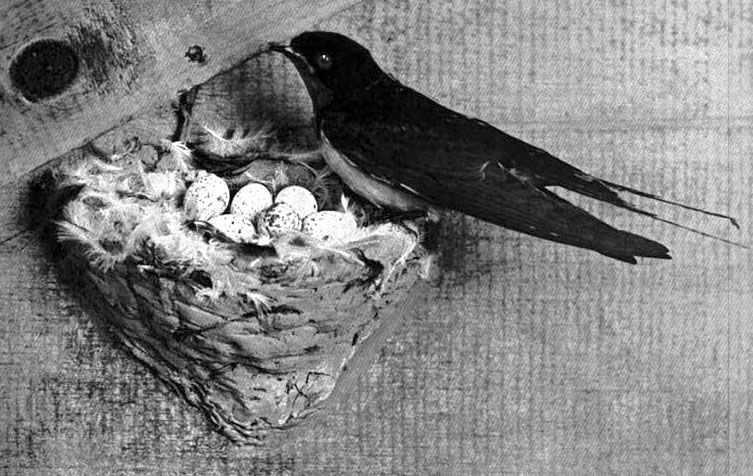
 The excerpt above, from the 1818 Memoirs of the Philadelphia Society for the Promotion of Agriculture, is notable in a variety of ways. First, it represents the perspective of a "humble ploughman," not the typical "gentleman farmer" reader. Second, it retells the old story of the relationship between the absence of wild birds and the increase in noxious insects. And finally, it represents a genuine plea, addressed not to legislatures but to "printers," that a variety of bird species, including "blackbirds, robins, jays, catbirds, swallows, and sparrows" be spared from sports shooting.

And indeed, some printers were listening. The Alexandria Herald repeated a story that was credited to a "Concord paper" in a column on  July 25, 1817, both accepting the ploughman's explanation and calling not just for special protection for the swallow but for its promotion.
On what principle to account for [the large number of destructive insects] we were at a loss, until the suggestion from an experienced agriculturalist, that the cold season of 1816, either drove away or destroyed those useful birds, particularly the swallow, which appear to subsist on air, but in fact feed on the myriads of insects with which the air abounds....
The swallow claims our protection, not only because it is inoffensive, but because it protects our fields, our gardens--nay, our lives; for who knows that the same insects which lay waste the one, do not generate those diseases which destroy the other? Some farmers are in the habit of shutting up and darkening their barns and outhouses to prevent these birds from building their nests and rearing their young. We think an act of the legislature paying a bounty on the rearing of swallows would be as useful to the community as the passing of a law paying a bounty for killing crows.
Note the typical economic ornithological practice of separating birds into "good" and "bad." Not everyone would be so hard on crows.

Wednesday, July 3, 2013

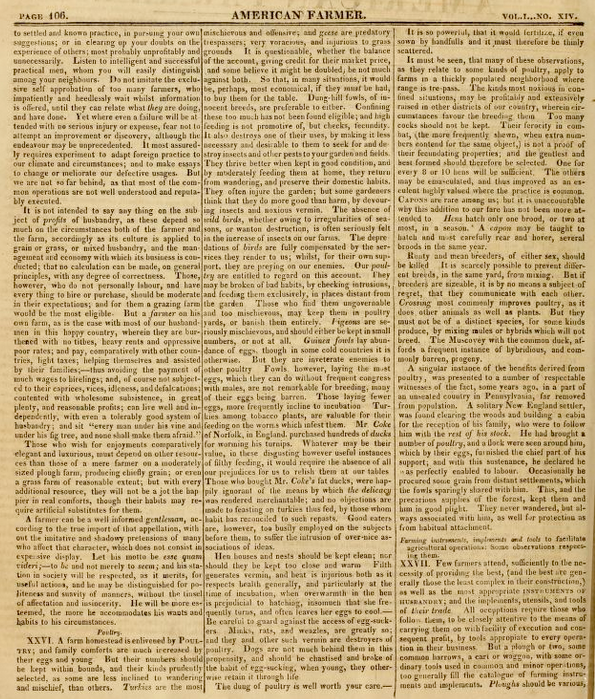
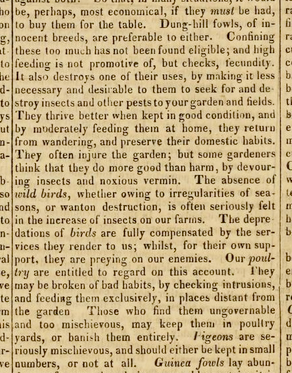
The usefulness of dunghill fowl. American Farmer July 2, 1819.

American Farmer, July 2, 1819 (Vol I, No. 14, p. 106)
On July 2, 1819 Skinner ran the second half of a long edited extract, "Notices for a Young Farmer," originally appearing in the Memoirs of the Philadelphia Agricultural Society. In a section on poultry, the writer strongly advises against turkeys and geese but recommends an alternative:

Dung-hill fowls, of innocent breeds, are preferable to either. Confining these too much has not been found eligible; and high feeding is not promotive of, but checks, fecundity. It also destroys one of their uses, by making it less necessary and desirable to them to seek for and destroy insects and other pests to your garden and fields....They often injure the garden; but some gardeners think that they do more good than harm, by devouring insects and noxious vermin. The absence of wild birds, whether owing to irregularities of seasons, or wanton destruction, is often seriously felt in the increase of insects on our farms. The depredations of birds are fully compensated by the services they render to us; whilst, for their own support, they are preying on our enemies. Our poultry are entitled to regard on this account.
Dunghill fowl were essentially mixed-breed barnyard chickens.

It is worth noting that domesticated fowl were the original "useful" birds, a source of human food with the special bonus of being insectivorous. While pure-bred fowl might need some confinement, dunghill fowl were perceived as benefiting from their free range diet and benefiting farmers by keeping down fly populations and devouring harmful insects in the garden. As with wild birds, any depredations in the garden were compensated by "the services they render to us."


Monday, July 1, 2013

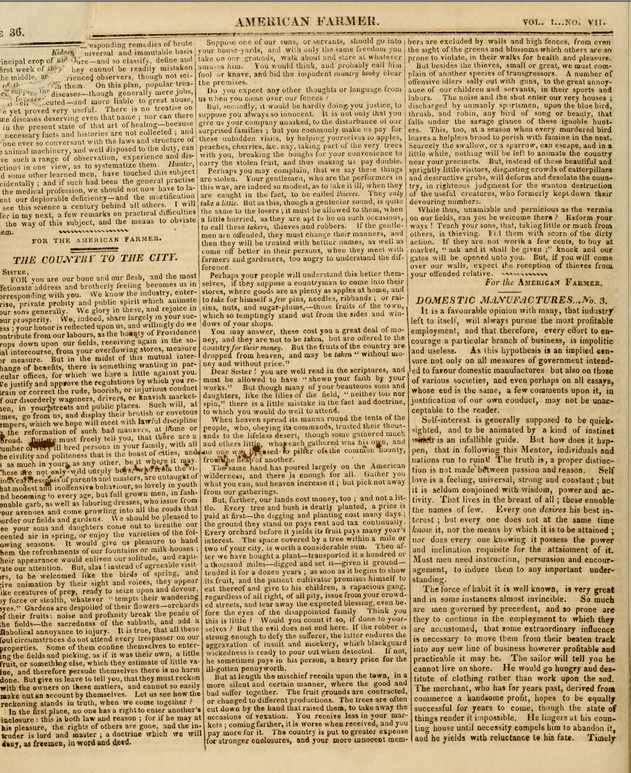
Ignoble hunters from the city. American Farmer, May 14, 1819.


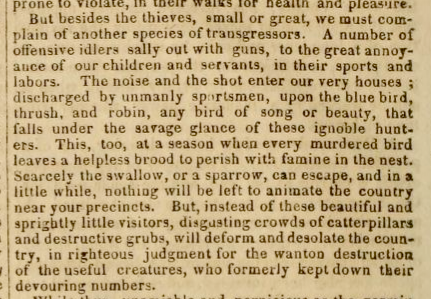
The first extended mention in the American Farmer of the need for bird protection can be found in the May 14, 1819 (Vol I, issue 7, page 52) edition in the context of a piece voicing complaints about the behavior of city folk visiting the countryside.  Addressed to "sister" and titled, "The country to the city," the article (probably written by John S. Skinner himself) is mostly a complaint about casual thievery from orchards and flower beds, but ends with an additional complaint about the cruelty shown by "ignoble hunters" from the city to birdlife.


Here is the full text, hopefully more readable, below:
But besides the thieves, small or great, we must complain of another species of transgressors. A number of offensive idlers sally out with guns, to the great annoyance of our children and servants, in their sports and labors. The noise and shot enter our very houses; discharges by unmanly sportsmen, upon the blue bird, thrush, and robin, any bird of song or beauty, that falls under the savage glance of these ignoble hunters. This, too, at a season when every murdered bird leaves a helpless brood to perish with famine in the nest. Scarcely the swallow, or a sparrow, can escape, and in a little while, nothing will be left to animate the country near your precincts. But, instead of these beautiful and sprightly little visitors, disgusting crowds of catterpillars (sic) and destructive grubs, will deform and desolate the country, in righteous judgment for the wanton destruction of the useful creatures, who formerly kept down their devouring numbers.
Compressed into this single paragraph are a number of separate arguments against the shooting of songbirds, versions of which we have seen before
  • The aesthetic, picturesque value of birds of "song and beauty" (blue bird, thrush, robin, swallow, sparrow) animating the countryside . [Addison & Steele]
  • The inhumane cruelty of killing adult birds during breeding season. [Trimmer]
  • The plague of caterpillars and grubs resulting from the sin of killing birds [Bradley, Franklin]
  • The "usefulness" of birds [Barton, Wilson]
It is unknown whether Skinner actually held this belief or was just reproducing a common complaint from the point of view of his readership. Skinner would later be a great promoter of hunting, but under the model of the restrained "sportsman," not the "offensive idler."

This article was reprinted in the very first issue of the short-lived Boston farm paper, the Agricultural Intelligencer and Mechanic Register, January 10, 1820.  

Sunday, June 30, 2013

The Farm Press and the Roots of American Conservation


The American agricultural periodical is a largely forgotten medium. In the 19th and early 20th centuries, however, it was an energetic, popular, and in some respects, cutting-edge source of information. According to Richard W. Judd, in his 1997 book, Common Lands, Common People, the roots of the American conservation movement can be found in the farm press of the mid-1800s. And it is worth noting that Henry David Thoreau was an attentive reader of agricultural papers.

Most historians place the birth of the first real agricultural newspaper in 1819, with the publication of The American Farmer, edited in Baltimore by John S. Skinner.  The New England Farmer, edited by Thomas Green Fessenden, followed in 1822. By 1860 hundreds of papers had entered the field with an estimated total circulation in the hundreds of thousands.

In the earliest days of the farm press the papers were a mix of written editorial, reader correspondence, and extracts from material published elsewhere. The early readership largely comprised elites looking for scientifically-established innovations and best practices in farming, the raising of live-stock, and horticulture.  The American Farmer had a special relationship with the Pennsylvania Agricultural Society and the New England Farmer was closely linked to the Massachusetts Society for Promoting Agriculture and the Massachusetts Horticultural Society.

Among the topics discussed in the pages of the agricultural press was the issue of bird protection. In fact, Judd argues that debates about the issue in the mid-1800s "set the tone for the bird protection movement at the end of the century."  The utilitarian value of insectivorous and seed-eating birds to the farming economy (birds as "the farmer's best friend") was ultimately the reason non-game birds gained federal protection in the United States; agricultural papers along with the growing academic field of economic ornithology developed this line of thought. Judd, notes, of course, that the economic ornithologists' project of classifying birds into "useful, noxious, and uncertain" was always accompanied by aesthetic and anthropomorphized ethical judgements. (We've already seen the seeds of this in Alexander Wilson's writings).

Judd's account of bird protection discourse in the farm press begins in the 1840s but examples of arguments for and against the protection of certain birds can be seen early on in both the American Farmer and the New England Farmer.  The next series of blog posts will feature these papers.

Thursday, June 20, 2013

Mrs. Trimmer's Talking Robins

Illustration from 1901 edition of The History of the Robins

Mrs. (Sarah) Trimmer's first principle in respect to the treatment of birds and other animals was Christian mercy. It would be tempting to assign her to the "sentimental" camp in the history of bird protection if only she hadn't herself put so many bounds around the proper application of such mercy. To begin, it was sinful to feed to animals food fit for human consumption--poor and destitute humans were more worthy recipients for leftovers. At the same time, it was also sinful to throw away crumbs that had fallen to the floor--those should go to the birds. While cruelty to animals was morally abhorrent, so was intemperate love of one's pets. Human needs always came first, but humans needed to empathize as much as possible with inferior beings (whether work horses or house flies).

Trimmer dramatized these principles in a pair of books, An Easy Introduction to the Knowledge of Nature, and Reading the Holy Scriptures, Adapted to the Capacities of Children (1770) and Fabulous Histories Designed for the Instruction of Children Respecting their Treatment of Animals [AKA The History of the Robins] (1786).  In the first, Trimmer used dialogue between a wise mother and her two children to convey the wonder of God's "book of nature." In the second, Trimmer narrated the intersecting stories of a family of (European) robins and two young human children (with the wise mother character never far away). The novelty of Fabulous Histories was the depiction of the robins as thinking and speaking beings, a bit of poetic license that Trimmer took pains to try and disenchant.

With respect to attitudes toward birdlife, An Easy Introduction displays beliefs consistent with those of Joseph Addison and Richard Steele earlier in the century. The mother character repeats Addison's line about blackbirds and cherries almost verbatim and reveals that she would sometimes buy captive larks at the marketplace in order to release them in the wild. Ultimately, however, birds lacked "souls" (which coincided, for Trimmer, with cognition and the ability to speak) and thus were inherently inferior to humans.

By the time she wrote Fabulous Histories, however, her thoughts about birds and speech seem to have shifted a little, which made the need for mercy even more pressing. Here's the wise mother counseling her daughter about trying to raise wild chicks in the home:
I cannot think you have any cruelty in your nature, but perhaps you have accustomed yourself to consider birds only as playthings, without sense of feeling. To me, who am a great admirer of the beautiful littler creatures, they appear in a very different light; and I have been an attentive observer of them I assure you. Though they have not the gift of speech like us, all kinds of birds have particular notes which answer in some measure the purpose of words among them, by means of which they can call to their young ones, express their love of them, their fears for their safety, their anger towards those who would hurt them, etc. from which we may infer that it is cruel to rob birds of their young, deprive them of their liberty, or exclude them from the blessings suited to their natures, for which it is impossible for us to give them an equivalent.
Besides, these creatures, insignificant as they appear in your estimation, were made by God as well as you. Have you not read in the Testament, my dear, that our Saviour said, "Blessed are the merciful, for they shall obtain mercy?"
While the killing of animals was sometimes necessary for human benefit, it was never to be done thoughtlessly. On the contrary, it should be ruled by empathy.
I am of the opinion... that it would be a good way to accustom one's self, before one kills anything, to change situations with it in imagination, and to suppose how we feel were we bees, or ants, or birds, or kittens.
And this is precisely what Trimmer did in making robin-speak intelligible to readers and presenting family relations (quarrels, power struggles, parental discipline) between robins as very human-like. It allowed the young reader to imagine the world from an putative robin's point of view.  The robin story became so popular that later editions would drop much of the children's story (and their tours of the twin grotesqueries of animal torture and pet over-indulgence) to focus on these anthropomorphized characters.

In addition to offering a specific argument (Christian mercy) for the protection of birds, Fabulous Histories is also a useful guide to late 18th century attitudes toward certain bird species. As we've seen before, robins ("Babes in the Woods") and swallows (insect-eaters) got a free pass, while bullying, stealing house sparrows deserved their persecution. Trimmer used other species to convey certain moral  points linked to their natural behavior.  Chattering magpies, for example, were foolish--always talking, never listening, while cuckoos were lazy, house-stealing foreigners. Trimmer even imported a mockingbird character (with an appropriate footnote indicating its American origin) to show how children how ridicule is funny until directed at one's self.


Thursday, June 9, 2011

Alexander Wilson vindicates the kingbird


Alexander Wilson's American Ornithology, published in a series of volumes (one posthumously) from 1808 to 1814, was not only the foundational guide to the birds of the United States but a crucially important set of arguments in favor of bird protection. Wilson's approach to ornithology famously combined close scientific description and reasoning with an overarching moral sensibility. Wilson's mission was not just to describe the birds of America but to "vindicate them from every misrepresentation."

According to Wilson, some birds were unfairly persecuted for reasons of superstition (whip-poor-will, storm petrel) and others because they were perceived as threats to agriculture. Some, such as the catbird and green heron, just seemed to be generally disliked and persecuted for no reason in particular. Of these persecuted birds, Wilson fails to exonerate only the magpie, common crow, and the cedar waxwing, and even these get partial support.

Some of Wilson's methods of argument we've seen before. For example, in defending the red-winged blackbird ("let the reader divest himself of prejudice!"), Wilson points out how many destructive insects a blackbird would ultimately destroy in a year.

Wilson knows, however, that this method will not be sufficient to defend the common crow.
To say to the man who has lost his crop of corn by these birds, that crows are exceedingly useful for destroying vermin, would be as consolatory as to tell him who had just lost his house and furniture by the flames, that fires are excellent for destroying bugs.
So he supplements this line of defense by pointing to the inherent worth of the animal.
The crow is easily raised and domesticated; and it is only when thus rendered unsuspicious of, and placed on terms of familiarity with, man that the true traits of his genius and native disposition fully develop themselves.
Nevertheless, he grants farmers their "honest indignation" against the common crow, asking only that the harmless fish crow not be mistakenly targeted.

For the cedar waxwing, on the other hand, the problem seems to be that its fruit depredations are not balanced by enough positives.
Their usefulness to the farmer may be questioned; and in the general chorus of the feathered songsters they can scarcely be said to take a part.
[Note: while it is true waxwings lack much of a song (I, personally, find their buzzy notes rather soothing) later studies have shown that they are significant consumers of insects].

The most striking example of Wilson's vindications is probably his poetic defense of the kingbird, persecuted for catching honey bees. Wilson's introduction to the poem, "The Tyrant Flycatcher, or King Bird" is worth reading in its entirety:
Great prejudices are entertained against this little bird; I, however, honour him for his extreme affection for his young; for his contempt of danger, and unexampled intrepidity; for his meekness of behaviour when there are no calls upon his courage; but, above all, for the millions of ruinous vermin of which he rids us!
As a friend to this persecuted bird, and an enemy to prejudices of every description, will the reader allow me to set this matter in a somewhat clearer and stronger light, by presenting him with a short poetical epitome of the King-bird's history.
Wilson's claims of usefulness ("I can assure the cultivator that this bird is greatly his friend in destroying multitudes of insects"), are combined with scenes dramatizing the bird's noble and heroic character.

It is a long poem, the kingbird's domestic heroism taking up most of the verses. For our purposes, the most meaningful passage occurs at the end, when a hunter is depicted stalking the bird.
See where he skulks, and takes his gloomy stand,
The deep-charged musket hanging in his hand,
And, gaunt for blood, he leans it on a rest,
Prepared and pointed at thy snow-white breast.
Ah! friend, good friend, forbear that barb'rous deed,
Against it, valour, goodness, pity plead;
If ere a family's griefs, a widow's woe
Have reached thy soul, in mercy let him go!
By anthropomorphizing the bird, and telling of its noble character, Wilson draws the reader's sympathies toward the bird and away from the human hunter. Note, the hunter is not evil ("friend, good friend"), instead a reasonable man who might be moved to show mercy. Indeed, it is ultimately in the hunter's self-interest not to harm the bird.
Yet should the tear of pity nought avail;
Let interest speak, let gratitude prevail;
Kill not thy friend, who thy whole harvest shields,
And sweeps ten thousand vermin from thy fields.
Think how this dauntless bird, thy poultry's guard,
Drove ev'ry hawk and eagle from thy yard;
Watch'd round thy cattle as they fed, and slew
The hungry, black'ning swarms that round them flew;
Some small return, some little right resign,
And spare his life whose services are thine!
But Wilson is a realist, recognizing that some will be unmoved by his pleas. (He also knows that a tragic ending will have more impact).
I plead in vain! amid the bursting roar
The poor, lost King-bird, welters in his gore.
While Wilson's original volumes were far too expensive to have wide-spread impact, it wasn't long until they were published in more affordable editions. These would have enormous influence in public discourse about bird protection in years to come.

Friday, May 13, 2011

Joseph Addison's Blackbirds (and Richard Steele's Tom-tits)


I value my Garden more for being full of Blackbirds than Cherries, and very frankly give them Fruit for their Songs.
Joseph Addison Spectator #477 September 6 1712

Addison's blackbirds-over-cherries admission is widely quoted today, though I have no evidence it was very influential in the early days of bird protection. Nevertheless, it provides a different basis for protection than the strict utilitarianism of the economic ornithologist. And pre-dates Richard Bradley's arguments in favor of the house sparrow in the history of pro-bird discourse. [Note: the European blackbird, a splendid songster (essentially a black thrush), is no relation to the red-winged blackbirds and grackles that so harried the colonists in the New World]

The context for the Addison quote is a longer piece in the Spectator in which he describes his admittedly idiosyncratic garden preferences.
There is another Circumstance in which I am very particular, or, as my Neighbours call me, very whimsical: As my Garden invites into it all the Birds of the Country, by offering them the Conveniency of Springs and Shades, Solitude and Shelter, I do not suffer any one to destroy their Nests in the Spring, or drive them from their usual Haunts in Fruit-time. I value my Garden more for being full of Blackbirds than Cherries, and very frankly give them Fruit for their Songs. By this means I have always the Musick of the Season in its Perfection, and am highly delighted to see the Jay or the Thrush hopping about my Walks, and shooting before my Eye across the several little Glades and Alleys that I pass thro'.
Addison's attachment to his birds is less sentimental than aesthetic. They help to complete the picturesque effect of his garden, adding movement and sound to the overall scene. This WILL be a theme that we will see repeatedly in the agricultural literature--the importance of bird life to the ideal rural picturesque.

While Addison cannot really be called a natural historian, it is clear that he, and his publishing partner Richard Steele, were interested in a variety of natural history topics, including the question of reason and instinct. Addison was curious and knowledgeable about bird life, able to identify various species by sight and song, and admits he has been "caught twice or thrice looking after a bird's nest" (Spectator 120 July 18 1711). Steele, of course, would publish one of the foundational texts in the animal rights movement, Alexander Pope's essay "Against Barbarity to Animals" in the May 21, 1713 edition of the Guardian.
I fancy too, some advantage might be taken of the common notion, that it is ominous or unlucky to destroy some sorts of birds, as Swallows or Martins; this opinion might possibly arise from the confidence these birds seem to put in us by building under our roofs, so that it is a kind of violation of the laws of hospitality to murder them. As for Robin-red-breasts in particular, it is not improbable they owe their security to the old ballad of the Children in the Wood. However it be, I do not know, I say, why this prejudice, well improved and carried as far as it would go, might not be made to conduce to the preservation of many innocent creatures, which are now exposed to all the wantonness of an ignorant barbarity.
It is worth noting how Pope uses existing popular protection of swallows, martins, and robins as a model for animal protection generally. And that the final cause is not innate cruelty as much as ignorance, a theory of motivation that would determine the course of communication in favor of bird (and animal) protection in the future.

Steele, in fact, had raised the issue of cruelty to animals some years earlier in the Tatler (under the persona of Isaac Bickerstaff). In a February 16, 1709 article, on "Cruelty to Animals," he responds to a note from "Job Chanticleer," delivered by an "ancient Pythagorean." Chanticleer petitions Bickerstaff to save him and his fellow roosters from the barbarism of Shrove Tuesday (which featured "cock throwing.") This becomes a jumping off point for Bickerstaff to consider and condemn other acts of cruelty, including bear baiting and the like. Two passages are of particular interest for our purposes, however. First, Chanticleer is encouraged to petition Bickerstaff because of his "great humanity toward Robin Red-breasts and Tom-tits." In other words, "Bickerstaff"/Steele was already renowned for his (idiosyncratic?) protection of birds. Second, he has the Pythagorean relate stories of the "East," where, for example, "nothing is more frequent than to see a Dervise lay out a whole year's income for the redemption of larks or linnets, that had unhappily fallen into the hands of bird-catchers." [This figure is repeated later in the year (Dec 27, 1709) when Bickerstaff praises a young boy who "has given his brother three half-pence, which was his whole estate, to spare the life of a Tom-tit."] The "Pythagorean" position, at its most literal, was based on the idea of the transmigration of souls, and the fear that birds caged, tortured, or eaten might house the souls of former human beings. At a less literal level, it simply presented the commonalities of human and non-human and the slippages between the categories. (Addison, it should be noted, was responsible for a popular translation of Ovid's Metamorphoses).

As far as I can tell the Pythagorean perspective per se wouldn't really play a strong role in American agricultural press discourse about bird protection, though it certainly was present in early anti-cruelty movements generally in the United States. Nevertheless it is useful to consider as a very early precursor of the public debates to come.